Claude Certified Architect - Practices, Tips and Tricks
By Kuldeep Singh
- 3 minutes read - 638 wordsThe AI world is rapidly shifting from chatbots to agents.
From simple prompting to orchestration.
From asking questions to building systems that can reason, delegate, remember, retrieve, execute, and collaborate.
Over the last few months, I have been deeply exploring this transition through hands-on experiments around Agentic AI
Recently, I cleared the Claude Certified Architect (CCA-F) exam, and I wanted to share what genuinely helped me during this journey.
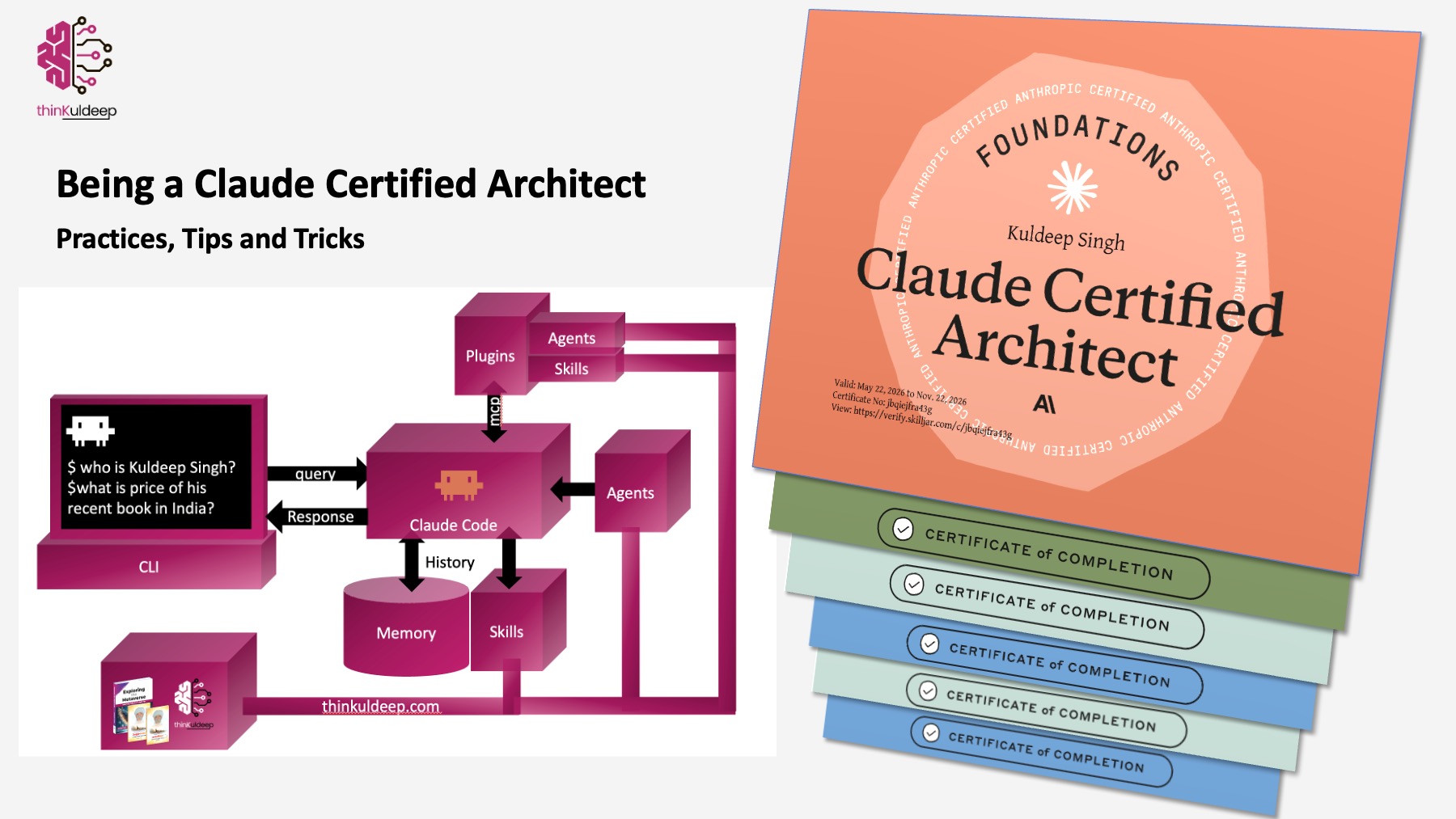
One important realization during this journey:
The certification is not testing whether you can use AI.
It tests whether you understand how to architect AI systems responsibly and effectively.
And honestly, that makes the learning journey far more valuable than the badge itself.
The Biggest Mistake People Make
Many people jump directly into:
- practice exams,
- cheat sheets,
- or prompt collections.
But the actual exam is heavily scenario-based. You are expected to understand:
- why one approach is better than another,
- trade-offs between tools and orchestration patterns,
- context handling,
- delegation strategies,
- memory optimization,
- and practical engineering workflows.
The more hands-on practice you do, the easier the concepts become.
What Actually Helped Me
I had already been sharing multiple practical articles and experiments around Agentic AI before attempting the certification.
Those experiments became the real preparation.
Some of the articles I previously shared include:
- A Path to GenAI and Agentic AI
- Building GenAI Solutions
- AI Integrated Development Environment
- Developing AI Agents
- Agentic AI – A Local Setup
- Claude as Agentic AI
Along with continuous experimentation using: Claude Code. MCP servers, Multi-agent patterns, Prompt workflows and Tool integrations
Reading alone is not enough.
Build:
- small agents,
- tool integrations,
- MCP workflows,
- retrieval systems,
- automation flows.
Even tiny experiments teach a lot.
All hands-on examples are available at: AI Practices GitHub Repository
Topics You Should Definitely Understand
You do not need to become an expert in every area, but you should comfortably understand concepts like:
CLAUDE.mdhierarchy - Global, Nested, Project, Local- Context and memory management - Auto-memery,
/memory, checkpoint/rewind - MCP architecture - one client, many servers. each server exposes typed capabilties
- Skills, tools, prompts, hooks.
- Multi-agent orchestration and delegation patterns -
- Session management and isolation -
-resume, - Prompt engineering
- Context optimization, summarization, progressive disclosure.
- Subagents and claude Code workflows
- Evaluation and reasoning patterns - Reading dept, how hard to think, Plan, Ultraplan mode
- Parallel execution - One session and Subagents, Parallel Clade Sessions, Agent Teams
Most importantly: understand when to use what.
The exam focuses more on architectural thinking than feature memorization.
Courses That Helped
I also found the Anthropic learning paths quite useful.
- Claude Code in Action - Practical understanding of Claude Code, workflows, MCP, and AI-assisted development.
- Building with the Claude API - Helpful for orchestration, prompting, tools, and architectural patterns.
- Introduction to Agent Skills - Good understanding of skills, delegation, and workflow management.
- Introduction to Subagents - Useful for isolated execution and delegated workflows.
More courses: Anthropic Skilljar Portal
I also got access to partner learning programs through Thoughtworks, which helped structure the learning journey further.
About the Exam
The Claude Certified Architect Foundations (CCA-F) exam contains:
- 60 objective questions
- 120 minutes duration
- Passing score: 720/1000
The actual exam is harder than practice exam shared in CCA-F Exam Guide.
Do not try to memorize answers.
Instead:
- practice,
- experiment,
- build,
- and understand the reasoning behind architectural choices.
Registration: CCA-F Registration Portal only partner organization are allow currently.
Note:- This certification is valid only for 6 months, and keep learning…
Final Thoughts
We are entering a phase where software engineering is evolving into AI systems engineering.
The future is not just about writing prompts.
It is about:
- designing orchestrations,
- managing context,
- coordinating agents,
- integrating tools,
- and building reliable AI-native systems.
This certification journey helped reinforce that perspective for me. And the best way to learn this space is still the same:
Build. Break. Experiment. Improve. Share.
Keep Learning. Keep Building. Keep Sharing.
#evolution #ai #genai #technology #prompt #tutorial #learnings #mcp #development #agenticai #future #practice #claude #ide #integration