Claude Code for Agentic AI: From Foundations to Real Agents
By Kuldeep Singh
- 7 minutes read - 1289 wordsIn a previous hands-on articles, we built agents using local LLMs, and another article hands-on with AI-Integrated Development Environment using Claude Code. This article continues that journey,
Here the focus is different:
👉 How Claude Code becomes an Agent Platform — not just a coding assistant.
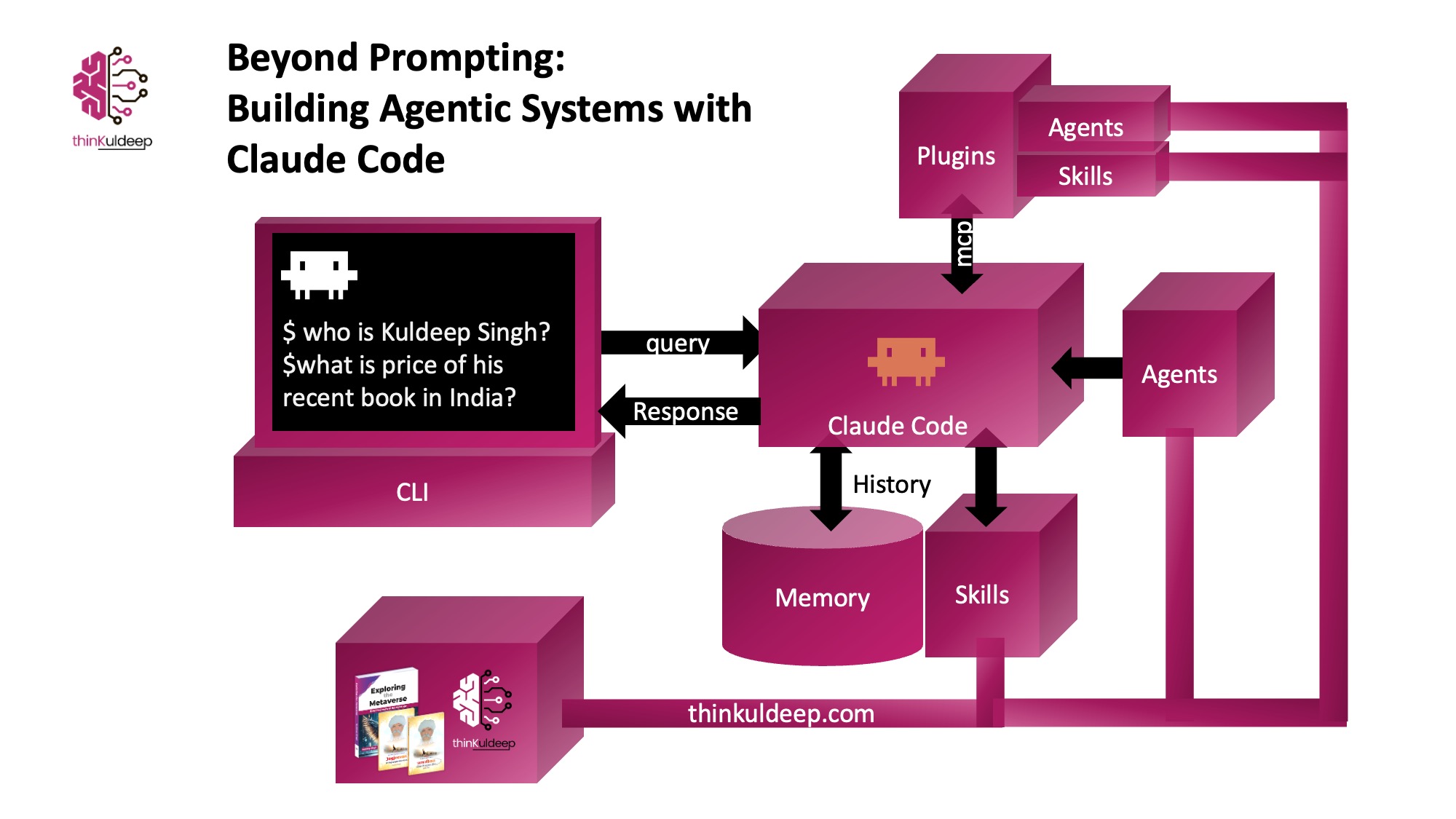
In this article, we will teach Claude how to work with us. We will progressively build: Skills, Agents, MCP tools, Plugin integrations amd by the end, Claude will act as: an About-Me agent, a Books price agent, and an externally powered MCP agent
This article is a fast practical foundation before deeper automation.
1. Starting a Claude Code Workspace
Create a fresh workspace:
mkdir cc-practices
cd cc-practices
cloude
Claude starts and loads configuration automatically and logs into if ANTHROPIC_API_KEY exists in environment.
Refer earlier article for mode details on setup. Complete source code is available at Github.
2. Understanding The Brain of Claude Code
Claude reads instructions from a file named: CLAUDE.md, and it act as it’s brain.
It can exist:
- project root
- subfolders
.claude/directory
👉 Nearest file wins.
This is extremely powerful. Instead of prompting repeatedly, you define permanent behavior.
To generate initial context run forward slash “/” - commands.
❯/
  /init                   Initialize a new CLAUDE.md file with codebase documentation
  /statusline             Set up Claude Code's status line UI
  /add-dir                Add a new working directory
  /agents                 Manage agent configurations
/init will scan the repository, understand structure. generate documentation automatically and create .claude/ configuration.
This commands are default skills, let’s add more skills to claude.
3. Claude Skills — Lightweight Agent Capabilities
Skills are the simplest form of agent behavior.
They live inside: .claude/skills/
A skill is essentially: 👉 a reusable operational prompt
Example: .claude/skills/about-me/SKILL.md
/about-me skill
# about-me skill
Fetch and present information about a known person or topic by retrieving content from their associated URL.
## Supported Queries
The following names map to URLs:
| Query | URL |
|-------|-----|
| Kuldeep Singh | https://thinkuldeep.com/about/ |
| Kuldeep Singh's books | https://thinkuldeep.com/about/books/ |
| Elon Musk | https://en.wikipedia.org/wiki/Elon_Musk |
## Instructions
1. Read the `$ARGUMENTS` to determine who or what the user is asking about.
2. Look up the matching URL from the table above.
   - If no match is found, respond: "No information available for: <query>"
3. Use the WebFetch tool to fetch the matched URL.
4. Extract and present only the plain-text paragraph content from the page, limited to the first 2000 characters.
5. Summarize or present the fetched content as a direct answer to the user's question.
Use this skill as command prompt
❯/about-me Kuldeep Singh
❯/about-me Kuldeep's books
It would return response like below
⏺ Fetch(https://thinkuldeep.com/about/books/)
⏺ Books by Kuldeep Singh
  Kuldeep Singh has authored and contributed to several publications:
  Authored Books:
  - Jagjeevan: Living Larger Than Life — A heartfelt tribute to the extraordinary life and timeless wisdom of Shri Jagguram, combining personal recollections with life lessons across ten chapters on heritage, resilience, responsibility, and
  gratitude.
  - Exploring the Metaverse — A comprehensive guide to the metaverse and the future of the internet, examining opportunities and challenges in emerging digital spaces.
  - My Thoughtworkings — An ebook launched during Thoughtworks' 30th anniversary, featuring insights from thirty employees including Kuldeep, reflecting on what shaped his professional journey.
Similarly, book_price skill got added, and we can ask book price now
❯ /book-price Jagjeevan, India
Claude now reads skill definition, Calls WebFetch, Extracts information, and Responds
No prompt engineering required anymore. However, Claude may use skill in response to a natural prompts as well.
We have created a reusable capability, but these are not agents, they are good for single shot. Let’s build Claude Agents.
4. Claude Agents — Autonomous Reasoning
Now we move to real Agentic AI. Agents live in: .claude/agents/
Example: .claude/agents/about-me.md
This is very similar to what we built as ReAct Loop in earlier article
Thought → Action → Observation → Answer
Find the Agent Source - about-me.md
Just reload the Claude, and it must be listed in : /agents, cloud would use it in with natural prompts as instructed.
❯ books writen by kuldeep using subagent about-me

⏺ about-me(Fetch books by Kuldeep)
  ⎿ Done (2 tool uses · 5.4k tokens · 17s)
  (ctrl+o to expand)

⏺ Here are the books listed on Kuldeep Singh's page:

  Written by Kuldeep Singh

  1. Jagjeevan: Living Larger Than Life — A tribute to Shri Jagguram covering themes of heritage, resilience, responsibility, and values. Described as a practical guide for a meaningful, value-driven life.
  2. Exploring the Metaverse — A comprehensive guide addressing the metaverse as the future of the internet, examining opportunities and challenges while emphasizing individual agency in shaping its evolution.
  3. My Thoughtworkings — An ebook created for Thoughtworks' 30th anniversary, featuring guiding thoughts from 30 colleagues that shaped Kuldeep's professional and personal journey.
Note:- We are providing instruction to use subagent in the prompt, to avoid Claude picking matching skill we added earlier. Otherwise, explicit mention is not needed.
Similarly, we added an agent to fetch book price, and get the price with naturally.
❯ get price of Jagjeevan and Exploring the Metaverse using subagent
❯ total price of these books

⏺ books-agent(Calculate total book prices)
⎿ Done (3 tool uses · 8.9k tokens · 35s)
(ctrl+o to expand)
⏺ Here are the total prices for both books in India:
Focus is not on prompting, but to design AI behavior here…
This completes porting our earlier agent into Claude Code, let’s move next advanced topic.
6. Introducing MCP — Model Context Protocol
Skills and Agents still rely on Claude’s internal tools.
MCP changes everything.
MCP allows: 👉 external programs to become native Claude tools.
MCP Server Configuration
.claude/.mcp.json
{
  "mcpServers": {
    "about-me": {
      "command": "python",
      "args": ["about-me-mcp-server.py"]
    }
  }
}
or register mcp server.
claude mcp add about-me python about-me-mcp-server.py
Restart Claude.
What the MCP Server Does
The Python server - about-me-mcp-server.py:
- exposes an about(query) function
- fetches websites
- parses HTML
- returns structured data
Claude now calls: mcp__about-me__about() instead of WebFetch as instructed in .claude/agents/about-me-mcp.md
❯ tell about Kuldeep Singh using agent about-me-mcp
⏺ about-me-mcp(Tell about Kuldeep Singh)
⏺ Here's what the about-me MCP tool returned about Kuldeep Singh:
  ---
  Kuldeep Singh is a technology leader with a "Tech@Core" approach, empowering businesses through innovation.
  Current Role
  - Global Emerging Technology Leader & Principal Consultant at Thoughtworks
  Professional Background
 ...
Here Claude invoked MCP tool, retrieved structured data, produced answer as per the agent. With this
we just connected Claude to a custom backend capability.
7. Claude Plugins — Packaging Capabilities
Next evolution:
👉 package MCP tools as reusable plugins.
Example: about-me-toolkit/.claude-plugin/plugin.json
Plugin defines:
- tools
- arguments
- install instructions
- MCP configuration
Install:
pip install -e about-me-toolkit
8. The Architecture Evolution - The Shift
What we built progressively:
| Level | Capability |
|---|---|
| Skill | Prompt automation, Single instruction, No reasoning loop and Fast automation |
| Agent | Autonomous ReAct reasoning, Multi-step decisions, Context aware |
| Python Agent | Custom execution loop, Multi-step decisions, Context aware |
| MCP Tool | External system integration,Language-agnostic, Reusable across clients |
| Plugin | Reusable AI capability distribution |
However the bigger realization is Claude Code is not an IDE feature.
It is becoming: An operating system for AI agents.
We don’t just ask questions. We design: behaviors, capabilities, workflows and intelligence boundaries
Think in layers: Prompt → Skill → Agent → Platform
Most developers stay at prompt level. Agentic engineering starts when you move beyond it. The real shift is not AI generating code.
The shift is: Developers designing intelligent systems that can act.
Claude Code provides one of the clearest paths today to move from: 👉 using AI to 👉 building with AI agents.
What Comes Next
In upcoming parts we will explore:
- Multi-agent orchestration
- Persistent memory
- Local + Cloud hybrid agents
- Long-running background agents
- Production agent governance
🔗 References
https://github.com/aipractices/ai-agents https://thinkuldeep.com/post/agentic-ai-hands-on/ https://thinkuldeep.com/post/agentic-ai-hands-on-2/ https://www.udemy.com/course/ai-agents/ https://medium.com/@rodrigo.estrada/build-a-local-ai-coding-assistant-qwen3-ollama-continue-dev-cee0dbcd172a https://kulkarnishreenidhi.medium.com/building-a-local-ai-agent-with-python-a-practical-implementation-guide-b45f71cffdfb
#evolution #ai #genai #technology #prompt #tutorial #learnings #mcp #development #agenticai #future #practice #claude #ide #integration