Why Engineering Experience (EX) is the New Competitive Advantage in the AI Era
By Kuldeep Singh
- 7 minutes read - 1283 wordsIn my previous article in this ELP series, I wrote about Engineering Budget Planning in the AI Era. The message was simple:
Don’t optimize engineering for lower cost. Optimize it for greater leverage.
Then in another article, I explored Platform Engineering as one of the ways to create that leverage.
Now, we may have better platforms, better automation, and increasingly capable AI, but when engineering leaders discuss productivity, the conversation usually revolves around delivery and outcome metrics. Very few ask a more fundamental question:
“How easy is it for our engineers to build great software?”
That question defines Developer Experience (DX) and AI pushing towards the broader term - Engineering Experience (EX)
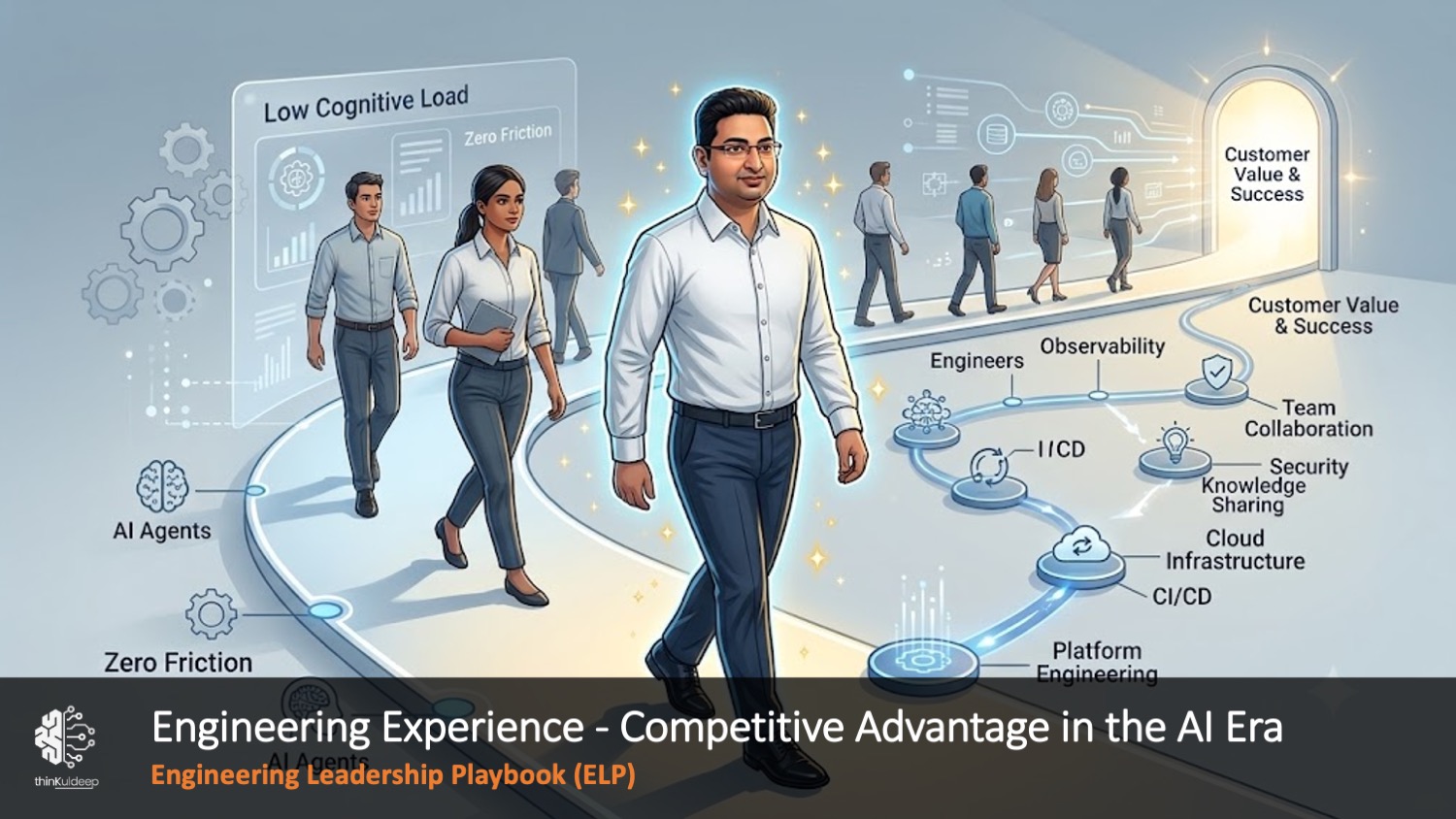
I believe EX is becoming one of the most important—and most underestimated—competitive advantages in the AI era.
Customers may never see your Engineering Experience. But they experience its consequences every day.
We optimized almost everything except the engineer
Over the last two decades, we have optimized almost every part of software delivery—cloud infrastructure, CI/CD, observability, automation, and now AI-assisted development.
But have we simplified the engineering experience?
We kept adding tools, treating engineering productivity as a tooling problem—better IDEs, faster machines, CI/CD, automation and documentation. Yet engineers still spend significant time finding information, getting access, navigating processes, coordinating across teams, understanding standards and ownership, and now reviewing AI-generated content to keep a human in the loop.
The EX is shaped by the entire journey: understanding the problem, finding knowledge, writing code, testing, deploying, operating and learning.
When each step involves a different system, process, team or approval, engineers spend more time navigating the engineering system than solving the problem.
We may be making development faster without making engineering easier.
The technology may be modern. The experience may not be.
AI makes this even more important
And now AI changes the scale of the problem. There is a tempting assumption:
If we can give every engineering task to an AI agent, engineering will become dramatically faster.
Imagine agents working in parallel—generating code, writing tests, following TDD and Agile practices, reviewing code, fixing bugs, creating documentation and investigating incidents.
💪 It sounds like the ultimate engineering organization.
But there is a deeper question: What experience are we giving to those agents?

If our engineering environment is already difficult for humans - unclear standards, fragmented tools, poor documentation, slow access, complex processes and unclear ownership - agents will experience the same friction, and AI can multiply it.
We may end up with hundreds of agents producing work at a speed humans cannot realistically review. The inefficiencies, assumptions and biases embedded in our Engineering Systems can therefore be multiplied at machine scale.
This changes the problem statement to from AI productivity gain to creating an engineering system where humans and AI can work in effectively.
AI can accelerate engineering. But without a deliberate EX, it can also accelerate the wrong things.
Design the engineering journey
So where do we start? - Look at the entire engineering journey.
Just like we spend enormous effort designing customer journeys - mapping touchpoints, identifying friction and continuously improving the experience. We should apply the same thinking to engineering.
Consider an engineer joining an organization/project:
- Day 1: Can they get what they need?
- Week 1: Can they understand the product, architecture and ways of working?
- Week 2: Can they make a meaningful contribution?
- Month 1: Can they deploy independently?
- Month 3: Can they improve the engineering system?
These are more than onboarding milestones. They reveal how well we have designed the EX. And the same journey exists across engineering—developers, QA, architects, SRE, DevOps, platform engineers and others.
When experienced engineers struggle to become productive, look beyond the individual.
Sometimes the system is the bottleneck.
Reduce cognitive load
Once we look at the entire journey, another problem becomes visible: cognitive load.
Every command to remember, system to navigate, approval to chase, exception to understand, or piece of tribal knowledge to discover consumes mental bandwidth that could otherwise go into solving the problem.
This is where Platform Engineering, AI and Engineering Experience come together.
Imagine an engineer simply expressing intent:
“Create a service using our standard architecture, security, observability and deployment model.”
The platform provides the capabilities and guardrails. AI helps execute the intent. The engineer provides the judgment. The complexity still exists - but it doesn’t all need to exist inside the engineer’s head.
That is what good Engineering Experience should achieve:
less friction, less cognitive load and more capacity for meaningful engineering.
From Engineering Experience to Customer Experience
This is where EX becomes a business issue. Poor Engineering Experience eventually shows up as slower delivery, more defects and incidents, higher engineering cost, more technical debt, and less innovation 🐞.
Customers don’t see the six approvals required for a deployment. They don’t see the 45-minute build. They don’t know that an engineer couldn’t find the right service owner. But They simply **experience the result as a feature that arrived late, a bug in production , an outage, a slow application and/or a missing capability.
The internal friction may be invisible. Its consequences are not.
Engineering Experience → Business Experience → Customer Experience
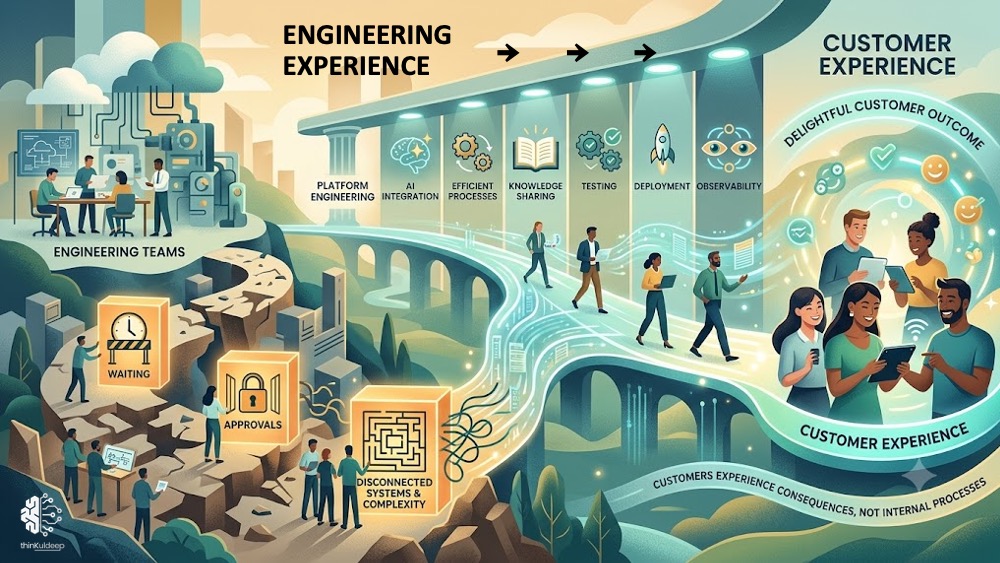
The less friction we create for engineering teams, the more of their capacity can become customer value.
Measure the engineering friction, not just outcome
Engineering organizations are already good at measuring outcomes in form of Deployment frequency, Lead time, Change failure rate, MTTR, Velocity and more.
They tell us what happened, speed and quality of outcome, but they don’t always tell us where engineering capacity was lost.
That is where EX measures can help, For example :
| Metric | What it tells us |
|---|---|
| ⏱️ Time to First Commit | How quickly engineers become productive |
| 🚀 Time to First Production Deployment | How quickly teams can deliver independently |
| 🔨 Build Time | How much waiting exists |
| ⚙️ Environment Provisioning Time | How effective self-service is |
| 📚 Knowledge Discoverability | How quickly engineers find answers |
| 🤖 AI Adoption | Whether AI is creating meaningful leverage |
| 🔄 Rework | How much effort is being lost |
| ❤️ Engineering Friction | Where engineers are losing time and energy |
And sometimes the simplest question is the most useful:
“What frustrated you this week?”
Then do something about it.
Engineering Experience is an investment in leverage
Engineering Experience is ultimately shaped by leadership—where we invest, how much governance we introduce, how teams are structured, what we automate, and how much autonomy we give engineers.
Some improvements require technology: better platforms, AI capabilities, automation and faster pipelines, while others are much simpler: Just the better documentation, fewer approval gates, clearer ownership, clearer standards, fewer unnecessary meetings and better communication 💬.
Sometimes, the biggest improvement is simply trusting engineers.
This is where EX connects to engineering economics. If an organization invests ₹200 crore annually in engineering, even a few percentage points of additional effective capacity can represent significant value.
The goal is not to make engineers work harder.
It is to eliminate the work they shouldn’t have to do—and turn that recovered capacity into engineering leverage.
🧭 Engineering Leadership Playbook Takeaway
Engineering Experience (EX) is about making it easier for people to do great engineering.
It brings together the people, platforms, processes, knowledge and AI that engineers rely on every day
AI can make individual tasks faster. Platforms can make capabilities easier to consume. But if the overall engineering experience is difficult, we may simply create more complexity at a much greater speed.
The real advantage will come from organizations that remove unnecessary friction and make it easier to turn engineering effort into customer value.
AI accelerates. Platforms scale. Engineering Experience helps people make the most of both.
Engineering Experience is the new competitive advantage in the AI era.
Find more articles in Engineering Leadership Playbook (ELP)
#ai #genai #engineering #leadership #playbook #learnings #development #assistant #aiagent #elp #experience #devX #budget #practice