Engineering Governance in the AI Era
By Kuldeep Singh
- 13 minutes read - 2633 wordsAs AI-assisted engineering accelerates software development, engineering governance becomes more essential than ever. A weak engineering practices and gaps in governance are exposed faster, with potentially greater consequences.
Engineering leaders responsible for multiple teams may get plenty of information via dashboards, delivery reports, risk registers, and status meetings. Yet a fundamental question remains:
Do we have confidence in the health of our engineering organisation, or are we simply confident in the status reports we receive?
A portfolio that looks green 🟢 while critical vulnerabilities remain unresolved ❌, technical debt accumulates 🔺, and engineering practices fall short of expectations 🔻. It may not be failures of individual teams, but of the systems used to establish expectations, gather evidence, manage risks, and drive decisions.
As part of the Engineering Leadership Playbook (ELP) series, this article introduces a practical engineering governance model to help engineering leaders bring visibility, accountability, and engineering excellence to scale.
Let’s first understand what is engineering governance, and what not.
1. Engineering governance is more than status reporting
An engineering leader may oversee dozens of teams across multiple products, platforms and business domains and each team may have it’s own manager, roadmap, backlog, delivery commitments and engineering practices. They receive status updates with a lot of information, but still there is growing concern of visibility. Usually, the problem is not a lack of information or team underperforming, but the inability to connect signals, assess risks, and drive timely action.
More reporting does not automatically produce more visibility. Better governance produces actionable visibility.
👉 A dashboard without accountability is merely information.
👉 A control without evidence is an assumption.
👉 A risk without an owner is an unresolved concern. and
👉 A status meeting without decisions is often just a reporting ritual.
Governance establishes expectations and accountability; management drives outcomes; assurance verifies controls; and observability reveals production health.
The goal is to replace reporting overhead with meaningful evidence, informed decisions, and continuous improvement—without compromising team autonomy, let’s understand the these principle more.
2. The principles of effective engineering governance
Effective engineering governance should be guided by a few core principles:
| 🎯 Outcomes over activity Measure value, delivery, quality, reliability, and risk—not activity counts. |
| 🚨 Guardrails over gates Automate routine controls; reserve human reviews for decisions requiring judgement. |
| 🧪 Evidence over assertions Base confidence on verifiable engineering evidence, not on unsupported claims. |
| ⚠️ Early signals over late surprises Identify emerging risks before they affect delivery or production. |
| 🤝 Autonomy within boundaries Give teams flexibility within shared engineering standards and controls. |
| 🙋 Accountability without blame Encourage transparency, learning, and timely corrective action. |
| 🔁 Continuous assessment Embed assurance throughout the software lifecycle, not just at release or audit time. |
| 📈 Measurement for decisions Every metric should inform an action, decision, or improvement. |
These principles are even more important in the AI era.
Faster software production does not guarantee better software. Governance must ensure confidence in what we deliver, not merely measure how quickly we deliver it.
3. A five-layer engineering governance model
Engineering governance can be organised into five connected layers, moving from engineering evidence to business outcomes.
| Layer 1: Engineering Evidence and Automation | |
|---|---|
| Collect signals from existing systems, including source control, CI/CD, automated testing, security scanning, deployment records, observability, and incident management. Tool availability alone is insufficient; evidence must demonstrate that controls are effective and issues are detected and addressed. | |
| Purpose: Establish reliable, automated evidence of engineering practices | Outcome: Less manual reporting, faster feedback, and greater confidence in engineering evidence |
| Layer 2: Team Delivery and Execution | |
| Combine engineering evidence with delivery commitments, estimations, work flow, quality trends, dependencies, and improvement actions. Focus reviews on exceptions, risks, and decisions rather than activity reporting. | |
| Purpose: Understand delivery confidence, blockers, and team health | Outcome: Clearer priorities, earlier intervention, and stronger team ownership. |
| Layer 3: Engineering Health and Assurance | |
| Evaluate quality, security, reliability, architecture, technical debt, and lifecycle practices against agreed expectations. Scale assurance to product criticality and identify systemic weaknesses that require shared solutions. | |
| Purpose: Assess engineering effectiveness and manage material risks | Outcome: Earlier risk detection, sustainable engineering practices, and targeted improvements. |
| Layer 4: Engineering Portfolio | |
| Consolidate delivery confidence, shared dependencies, capacity constraints, recurring bottlenecks, and common engineering risks across teams. Distinguish local problems from systemic issues requiring coordinated action. | |
| Purpose: Expose cross-team dependencies, constraints, and opportunities | Outcome: Faster dependency resolution, aligned priorities, and better use of shared capabilities |
| Layer 5: Business and Executive Outcomes | |
| Translate engineering insights into customer outcomes, strategic delivery confidence, material risks, capability gaps, and investment priorities. Present only the trends and decisions requiring executive attention. | |
| Purpose: Connect engineering performance to business value and investment decisions | Outcome: Better investment decisions and stronger alignment between engineering and business goals |
Connecting the layers
The five layers form a continuous feedback loop. Engineering evidence flows upward, gaining context at each level; priorities, decisions, support, and guardrails flow downward.
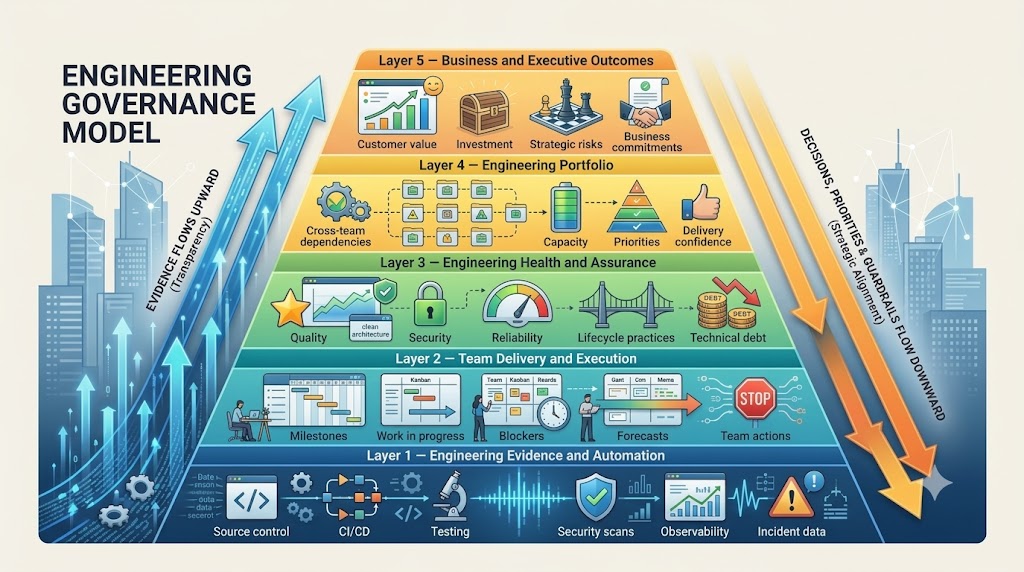
The evidence remains consistent, but its interpretation changes by audience. A failing test matters to an engineer, its delivery impact matters to an Engineering Manager, a shared pipeline constraint matters to an Engineering Director, and the resulting business risk matters to an executive.
The critical design choice is that not every layer needs every metric. A team needs actionable operational detail; an executive needs a concise view of outcomes, material risks and decisions.
This is a proposed framework, not an industry standard. Adapt it to the organisation’s scale, architecture, product criticality, regulatory obligations, and engineering maturity.
4. Governance across the software development lifecycle
Engineering governance is not just about delivering milestones, it is also about how effective the engineering practices are? A lifecycle governance matrix provides visibility through a small set of meaningful indicators, supported by clear expectations, evidence and ownership.
| Lifecycle phase | Key question | Example indicators |
|---|---|---|
| Discovery and requirements | Are we building the right thing? | Requirements readiness, unresolved dependencies |
| Architecture and design | Can the design meet expected needs? | Critical design risks, overdue decisions |
| Development and code review | Is the code maintainable and safe to integrate? | Change lead time, review delays, build success |
| Testing and quality | Do we have evidence that the change works? | Escaped defects, flaky tests, critical-path coverage |
| Security and compliance | Are risks controlled and exceptions visible? | Critical vulnerabilities, overdue remediation |
| Release and deployment | Can we release safely and recover quickly? | Deployment frequency, change failure rate, recovery time |
| Production operations | Is the service reliable for customers? | SLO attainment, incidents, time to recover |
| Maintenance and improvement | Are we learning and reducing technical debt? | Repeat incidents, ageing debt, overdue upgrades |
Teams should tailor these indicators to their architecture, product criticality, regulatory obligations and delivery model. The objective is not to measure everything, but to identify meaningful risks and improvement opportunities.
Governance should distinguish between mandatory controls, context-dependent practices, and opportunities for continuous improvement, adapting engineering practices to the needs and context of each team rather than applying them uniformly everywhere.
5. Define accountability and decision rights
A governance model fails when everyone sees a problem but nobody owns the decision, hence it is important to describe a practical division of responsibilities:
| Role | Primary governance responsibility |
|---|---|
| Engineering Head / VP | Engineering-wide standards, material risks, investment priorities and executive decisions |
| Engineering Director | Cross-team delivery, systemic risks, capability gaps and dependency resolution |
| Engineering Manager | Team commitments, engineering health, risk mitigation and improvement actions |
| Tech Lead / Architect | Technical decisions, architecture, design quality and technical debt |
| Quality / Security / SRE specialists | Domain-specific standards, evidence, assessment and remediation guidance |
| Product Manager | Customer outcomes, scope, priorities and business trade-offs |
Roles can vary by organisation. The important point is to explicitly define who owns the outcome, who supplies evidence, who makes decisions and who must be consulted.
Introduce a lightweight RACI or decision-rights matrix for key decisions such as accepting security exceptions, approving major architecture changes, changing release risk, and accepting residual technical risk. Avoid using RACI for every engineering activity.
6. Establish a governance rhythm
Governance needs a rhythm, but not every concern needs a weekly meeting.
| Forum | Cadence | Purpose |
|---|---|---|
| Team engineering review | Weekly | Delivery forecast, blockers, quality and actions |
| Cross-team engineering review | Weekly or fortnightly | Dependencies, material risks, shared technical concerns |
| Engineering health review | Monthly | Trends, standards adherence, incidents, technical debt and capability gaps |
| Portfolio and investment review | Monthly or quarterly | Outcomes, capacity, priorities and investment decisions |
| Deep-dive / assurance review | Risk-based | Investigate a critical product, control, service or engineering practice |
| Incident and learning review | After significant incidents | Understand causes, corrective actions and systemic improvements |
These are starting points, not mandatory frequencies.
Mature teams should be able to demonstrate routine compliance through automation and spend meeting time on exceptions, decisions and improvements.
7. Measure what helps leaders make decisions
A governance model can quickly become a collection of metrics. The challenge is to choose indicators that reveal engineering health and lead to better decisions. A useful measurement catalogue spans several dimensions.
| Dimension | Example indicators | Leadership question |
|---|---|---|
| Business outcomes | Customer outcomes, adoption, business milestones | Are we delivering the intended value? |
| Delivery | Lead time, deployment frequency, milestone predictability | Can we deliver reliably? |
| Quality | Escaped defects, test reliability, change failure rate | Are changes creating unacceptable quality risks? |
| Reliability | Service-level objective attainment, incident frequency, recovery time | Are services meeting customer expectations? |
| Security | Critical vulnerabilities, remediation age, exceptions | Is material risk controlled? |
| Engineering practices | Evidence of controls, unresolved gaps, remediation age | Are agreed practices effective? |
| Flow | Work in progress, blocked time, dependency delays | What is slowing delivery? |
| Developer experience | Onboarding time, developer feedback, friction hotspots | Can engineers work effectively? |
| Platform engineering | Adoption, self-service success, platform reliability | Are shared capabilities creating leverage? |
| AI adoption | Quality-adjusted cycle time, rework, review burden | Is AI improving outcomes without transferring costs downstream? |
| Technical sustainability | Ageing critical debt, unsupported dependencies, recurring incidents | Are we creating future delivery or reliability problems? |
These dimensions not needed in every dashboard. Teams need operational detail; engineering leaders need trends and exceptions; executives need outcomes and material risks.
A metric is useful when it can be interpreted against a target, baseline, threshold, or meaningful trend—and when that interpretation can inform an action.
Combine leading and lagging indicators
Lagging indicators show what has already happened, such as missed commitments, escaped defects, incidents, and service-level breaches. Leading indicators highlight emerging risks, such as growing work in progress, longer review times, unreliable builds, ageing vulnerabilities, and overdue mitigations.
Neither is sufficient alone. Connecting both helps identify patterns and address delivery or operational risks before they affect customers or commitments.
Avoid metrics that reward the wrong behaviour
Use metrics in context: deployment frequency does not equal productivity, code coverage does not prove test effectiveness, story points do not enable fair team comparisons, and AI-generated code volume does not measure value.
Never let composite scores hide critical security or reliability risks, or missing evidence appear green.
The goal is better decisions and outcomes, not team rankings.
8. Make governance visible through a small set of practical views
The model becomes useful when leaders can apply it consistently without creating a separate reporting system.
Four views are often sufficient to establish a starting point.
| 🎯 Executive engineering health A concise summary of delivery confidence, quality and reliability trends, material risks, unresolved decisions, and overdue mitigations. | 👉 Executive Engineering Health |
| 🤝 Team engineering health A view across teams showing delivery, quality, security, reliability, and engineering-practice signals, with links to supporting evidence. | 👉 Team Engineering Health |
| 🧪 Lifecycle assurance A view of whether relevant engineering practices are present, evidenced, effective, and improving—and where gaps need attention. | 👉 Practices Compliance & Assurance |
| 🚨 Risk and action register A shared view of material risks, dependencies, mitigation plans, accountable owners, target dates, and escalation triggers. | 👉 Risk, Dependencies & Actions |
The purpose is not to create a wall of charts. It is to help a leader answer three questions quickly:
Where do I need to pay attention?
What decision or intervention is required?
Who owns the next action?
9. Assess maturity to drive improvement, not compliance theatre
Assess each engineering practice individually to understand not just whether it exists, but how effectively it is implemented and improved.
👉 Expectation: The required practice or control.
👉 Evidence: Proof of implementation and effectiveness.
👉 Gaps and risks: Shortcomings, exceptions or exposures.
👉 Ownership: The person responsible and target date for remediation, where needed.
This is more useful than asking a team to declare itself “Agile,” “DevOps mature” or “compliant.”
Use a five-level maturity scale to assess each practice consistently.
| Level | Description | Example: automated testing |
|---|---|---|
| ❶Ad hoc | Inconsistent and largely manual | Tests run selectively |
| ❷Defined | Expectations and ownership are documented | Agreed testing guidelines exist |
| ❸Automated | Routine checks are integrated into delivery | CI runs the required test suites |
| ❹Measured | Effectiveness is monitored and reviewed | Flakiness, escaped defects and execution time are tracked |
| ❺Improving | Evidence drives systemic improvement | Test bottlenecks and recurring quality failures are systematically reduced |
Use this scale as a diagnostic tool, not a league table. Lower maturity should prompt targeted support, investment and improvement—not automatically become a performance judgement.
10. Introduce the model incrementally
Adopt the governance model in four stages:
- Establish visibility: Identify teams, products, owners, and leaders. Standardise reporting and maintain a shared risk and action register.
- Establish expectations and evidence: Define risk-based engineering practices, identify evidence sources, automate checks, and clarify accountability.
- Connect the portfolio: Aggregate team-level insights to identify dependencies, bottlenecks, systemic risks, and opportunities for improvement.
- Improve continuously: Refine metrics and address recurring gaps through platforms, automation, architecture, training, or operating-model changes.
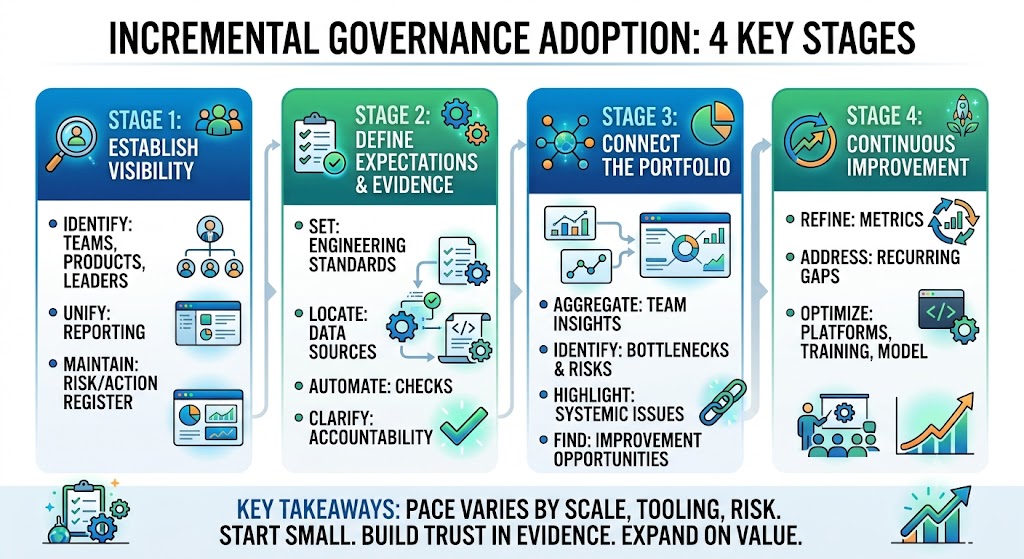
The pace will depend on organisational scale, tooling, and risk. Start small, build trust in the evidence, and expand based on demonstrated value.
11. Engineering governance in the AI era
AI accelerates code generation but does not guarantee customer value. Constraints may shift towards requirements clarity, reviews, testing, integration, security, and operations. Engineering governance must ensure that:
- AI-generated changes meet appropriate quality and security standards.
- Testing and reviews keep pace with change.
- AI’s impact on delivery, defects, rework, and engineering effort is measured.
- Teams retain ownership and accountability.
- AI tools operate within appropriate access and data-security boundaries.
The goal is not to create separate governance for every AI tool, but to strengthen the existing engineering system with risk-based controls.
The five-layer governance model connects automated evidence, team health, assurance, portfolio decisions, and executive investment to ensure AI-driven productivity translates into better outcomes.
Governance should enable safe, sustainable speed—not constrain it.
Conclusion: Confidence is the real measure of governance
Engineering governance is not about uniformity, centralised decisions, or endless metrics. It is about providing shared visibility, credible evidence, and clear expectations while enabling teams to operate autonomously.
Effective governance helps leaders identify risks early, make informed decisions, and drive improvements across teams. It gives engineers clarity, timely support, and the freedom to focus on delivering value.
As AI transforms software engineering, these capabilities become even more important.
The real measure of governance is how early it reveals problems, how confidently leaders make decisions, and how effectively the organisation learns and improves.
Practical resources
The model is easier to apply when teams can work with concrete examples. The following companion resources can help turn the concepts into practice:
- Weekly Engineering Status Template — a concise view of outcomes, delivery confidence, engineering health, risks, and decisions required. Good for engineering manager to create and engineering director to review, and this report generation tool may also be helpful.
- Weekly engineering leadership review - Guidelines for leadership review.
- Engineering Governance Dashboards — Example executive, team-health, lifecycle-assurance, and risk views.
- Engineering Risk Register — a consistent format for recording risk, impact, mitigation, ownership, and residual exposure.
- Engineering Practices Assessment — a way to assess lifecycle expectations, supporting evidence, gaps, and remediation.
- Engineering Decision and Action Tracker — a record of decisions, owners, target dates, and evidence of closure.
These resources are intended as starting points, not mandatory artefacts. They should be adapted to the organisation’s context, reuse evidence from existing tools, and remain useful only while they improve decisions and engineering outcomes.
#ai #genai #engineering #leadership #playbook #learnings #development #assistant #governance #elp #experience #devX #excellence #practice #measurement #metrics #model #management #quality